Bergorf Goodman
Bergdorf Goodman is a luxury goods department store based on Fifth Avenue in Midtown Manhattan in New York City. The company was founded in 1899 by Herman Bergdorf and was later owned and managed by Edwin Goodman, and later his son Andrew Goodman. more...Bergorf Goodman
- By:
- Posted 1/1/0001 12:00:00 AM
- 0 Comments
- 0 Views
- Rating: 0
Bergdorf Goodman is a luxury goods department store based on Fifth Avenue in Midtown Manhattan in New York City. The company was founded in 1899 by Herman Bergdorf and was later owned and managed by Edwin Goodman, and later his son Andrew Goodman.
Today, Bergdorf operates from two stores situated across the street from each other at Fifth Avenue between 57th and 58th Streets. Bergdorf Goodman's main store, which opened at its current location in 1928, is located on the west side of Fifth Avenue. A separate men's store, established in 1990, is located on the east side of Fifth Avenue, directly across the street.
Bergdorf is a subsidiary of Neiman Marcus, which is owned by the private equity firms TPG Capital and Warburg Pincus.
The company traces its origins to 1899 when Herman Bergdorf, an immigrant from Alsace, opened a tailor shop just above Union Square in downtown Manhattan.
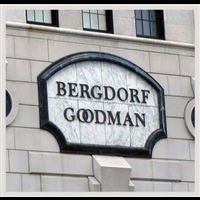
Bergdorf Goodman's main store on Fifth Avenue
Edwin Goodman, a young 23-year old merchant, based in Lockport, New York, moved to New York City to work as an apprentice for Bergdorf. Within two years, Goodman had raised enough money to purchase an interest in the business, which was renamed Bergdorf Goodman in 1901. in 1906, Bergdorf Goodman moved to a new location on 32nd Street, just west off Fifth Avenue and "Ladies' Mile". While Bergdorf preferred the less expensive side street location, Goodman with the location and bought out Bergdorf's interest in the company. Bergdorf would retire to Paris.
Although Goodman had developed a good business as a ladies' tailor on 32nd Street, in 1914, he decided to move uptown. Goodman constructed a five-story building at 616 Fifth Avenue, on the site of what is today Rockefeller Center.[1] In 1914, Goodman became the first couturier to introduce ready-to-wear, making Bergdorf Goodman a destination for American and French fashion.
The store moved to its present location at 5th Avenue and 58th Street in 1928, building its Art Deco store on the site of the Cornelius Vanderbilt II mansion. As he was unsure of the success of the new store's location, (it was uncertain whether customers would follow the store uptown), Goodman designed the new store so that it could be broken up into sections with different storefronts that could be rented out if needed. Early tenants included Van Cleef & Arpels, the Grande Maison de Blanc and Dobbs the Hatter.
[2] During the Great Depression, however, Goodman thrived, buying the entire building. Throughout the 1930s, Goodman purchased the mortgages of the surrounding businesses, eventually acquiring the entire block. During this period, Bergdorf Goodman was successful enough to have merited an expansion beyond the single store. However, Goodman preferred to operate in a single location where he would be able to personally maintain the quality of the merchandise and service.
[edit] The second generation (1951-1972)
Goodman's son, Andrew, assumed the role of president in 1951 and succeeded to the head of the company in 1953 following the death of his father.[3] Andrew was responsible for enhancing Bergdorf's reputation and expanding its range of merchandise and services.
During Andrew's tenure as chairman, Bergdorf opened a fur salon, developed the successful Bergdorf Goodman Number Nine perfume, and created Miss Bergdorf, a ready-to-wear line for younger customers.
The store began a $1 million expansion in 1959 into two adjacent buildings. The Boys and Girls gift shop expanded into a whole floor and the beauty salon and bridal, fur and men's departments also expanded. Eight years later, a $2.5 million expansion in 1967 nearly doubled the store's area, to 120,000 square feet (11,000 m2).[3]
[edit] New ownership (1972–1990)
In 1972 Andrew Goodman sold Bergdorf Goodman to Broadway-Hale Stores, which would become Carter Hawley Hale Stores for $12.5 million.[3]. CHH had acquired Neiman Marcus, a three-unit operation at the time, in 1969. By the time of the sale, Bergdorf Goodman was the only large high-quality specialty store in the U.S. that remained independently owned.[3] But its decision not to build suburban branches left it with a relatively modest profit margin. He remained the landlord of the store and kept a penthouse apartment on the building's top floor.[3]
A Badgley Mischka fur coat on display in the window of Bergdorf Goodman's Fifth Avenue store.
At first, CHH considered building branch locations, ultimately only constructing one location, in nearby White Plains, New York in 1972. This location was eventually converted to a Neiman Marcus branch store in 1981. To combat its image difficulties, the company hired Dawn Mello in 1975 as vice president of fashion. She was successful in reinvigorating the conservative store and became president in 1984. She left her post in 1989 to work for the floundering Italian fashion house Gucci, though she returned to her post as president in 1994.
Bergdorf Goodman's parent company became the object of takeover bids in the 1980s, and as a way to maintain its independence, Carter Hawley completed a major financial restructuring. In 1987, Bergdorf Goodman was spun off, together with Neiman Marcus and Contempo Casuals to form Neiman Marcus Group. The new company was headquarted in Dallas, Texas, where the significantly larger Neiman Marcus had been based for 80 years.
[edit] Reaching the centennial (1990–Present)
Chairman and CEO Ira Neimark expanded the women's store three times in the 1990s. The men's store was moved across the street to the old FAO Schwarz space at 745 Fifth Avenue in 1990. This move made it possible to make more space available for women's fashions. In 1997, the penthouse apartment on the building's ninth floor (formerly the Goodman family residence) was converted into the John Barrett Salon and Susan Ciminelli Day Spa. In 1999, the Beauty Level opened directly below the main floor, offering a luxury spa and Goodman's Café, serving lunch and afternoon tea.[4]
In 2002, Bergdorf Goodman underwent a major renovation, during which artisans and craftspeople began a dramatic restoration of the main floor of the women's store. In 2003, the store introduced new boutiques for Chanel, Giorgio Armani, Gucci, Versace, and Yves Saint Laurent. The Bergdorf Goodman Men's store features exclusive brands such as Loro Piana, Kiton, Brunello Cucinelli, John Lobb, Bontoni, Tom Ford, and Charvet. Bergdorf's competition includes other high-end retailers such as Bloomingdale's, Lord & Taylor, Barneys New York, Saks Fifth Avenue, and owner Neiman Marcus
On May 2, 2005, Bergdorf's parent company, Neiman Marcus Group, was acquired in a leveraged buyout (LBO), selling itself to two private equity firms, Texas Pacific Group and Warburg Pincus.[5]
[edit] In popular culture
Bergdorf Goodman has found its way into a variety of movies and television shows over the years. In the 1962 movie, That Touch of Mink, Doris Day is feted by Cary Grant with a shopping spree at Bergdorf Goodman's, and the store is mentioned several times in the film. In the credits of the film Bergdorf Goodman's is thanked "for being Bergdorf Goodman". On the 1974 wedding episode of Rhoda, Phyllis shows up late to the wedding and to the reaction of everyone, she replies "Well, apparently this dress is everything the woman at Bergdorf's said it would be." In the 1981 movie Arthur, Dudley Moore shops for sweaters when he sees Linda (Liza Minnelli) stealing a tie.
More recently, on the television series Sex And The City, Bergdorf Goodman was a favorite shopping spot for the main character, Carrie Bradshaw. The store on 5th Avenue in Manhattan was also featured in the opening for Sex and the City 2, the girls meet at the entrance of the store, and enter to buy Wedding gifts. On the show Boston Legal, Michael J. Fox's character tells Julie Bowen's character, "You know that coat you liked in the window of Bergdorf Goodman's? I'll buy you Bergdorf Goodman's." On the MTV series The City, Whitney Port's friend Samantha works as an assistant buyer at Bergdorf. Bergdorf also figured into the lyrics of Jay-Z's 2007 song, "30 Something". Also, Plum Sykes' 2005 novel Bergdorf Blondes makes significant use of the store and one of its main characters is a descendent of the founding Bergdorf family.















 350 5th Ave